November 13, 2026

How to Study for MCV4U Calculus Unit Tests

Short answer: take the unit's practice test cold, fix each miss at its source, and retest two days before. On a calculus unit, much of what goes wrong is MHF4U algebra; on a vectors unit, draw every question before you calculate. Martian Lab has free MCV4U practice tests from 20 years of tutoring YRDSB and TDSB students, with a free test in each of the 8 units.

How to study for any MCV4U unit test

  1. Find your unit: calculus or vectors

    Match the topics on your handout, not the unit number, which differs by school. The calculus units are Limits, Derivatives, Curve Sketching, Optimization and Derivatives of Trig, Exp and Log. The vectors units are Geometric Vectors, Cartesian Vectors and Lines and Planes. MCV4U units explained covers what each one holds.

  2. Take the unit's free test cold

    Before reviewing, do the unit's free practice test on paper with no notes, then mark it. The misses are your study list. Each unit page above has its free test, and Is MCV4U hard? says which units cost students the most.

  3. Calculus: trace each miss back to the algebra

    Much of what makes a derivative question hard is the MHF4U algebra inside it: factoring, rational expressions, trig identities and log laws. When a derivative goes wrong, check whether the rule or the algebra failed, and fix that. The calculus units also build on each other, so a curve sketching miss can be a derivative miss underneath. Start with the chain rule and the log laws.

  4. Vectors: draw it first

    Lines and planes questions ask you to picture objects in three dimensions. Sketch and label every question before you calculate, and sort intersection questions by case. Learn when a question needs the dot product and when it needs the cross product. The intersection of three planes topic page walks through every case.

  5. Retest two days before

    Redo your misses cold, then try the sample test below with the MCV4U formula sheet put away. For the final, read how to study for MCV4U.

Free MCV4U Sample Test

8 real questions, one from each unit, straight from the free tests on Martian Lab. Try each one on paper first, then open the answer and mark yourself.

  1. Limits

    Determine lim⁡x→24\displaystyle\lim_{x \to 2} 4.
    Show answer
    44
  2. Derivatives

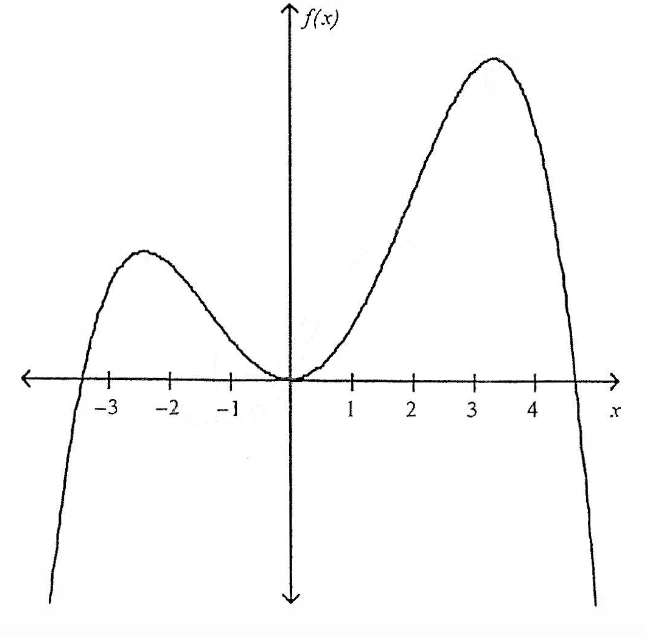
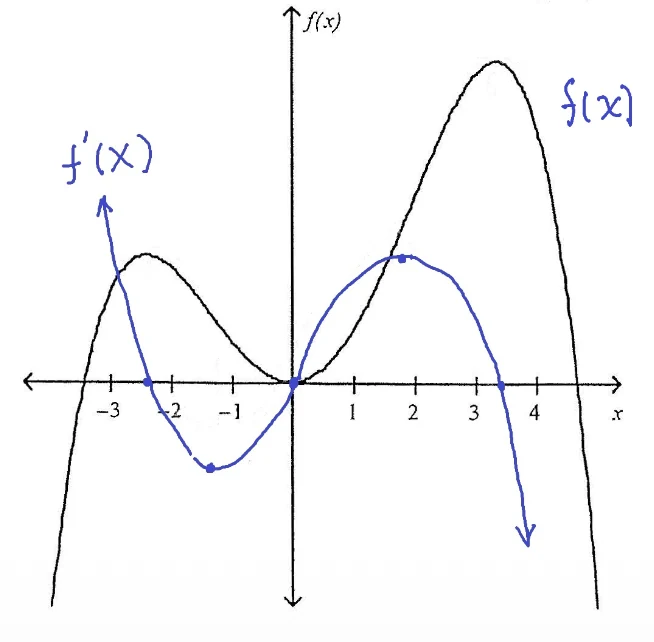
    Given the graph of y=f(x)y=f(x), give a rough sketch of the graph of y=f′(x)y=f'(x).
    Figure for the question
    Show solution
    Rough sketch of y=f′(x)y=f'(x).Worked solution
  3. Curve Sketching

    Given f(x)=x−4x2−x−2f(x) = \dfrac{x-4}{x^2-x-2}, complete the following over its entire domain. State the equation of the vertical asymptote(s) and use limits to analyze the behaviours of f(x)f(x) near its vertical asymptote.
    Show solution
    V.A.: x=2 , x=−1V.A. :\ x = 2\ ,\ x = -1 lim⁡x→2+f(x)=−∞\displaystyle\lim_{x \to 2^+} f(x) = -\infty lim⁡x→2−f(x)=+∞\displaystyle\lim_{x \to 2^-} f(x) = +\infty lim⁡x→−1+f(x)=+∞\displaystyle\lim_{x \to -1^+} f(x) = +\infty lim⁡x→−1−f(x)=−∞\displaystyle\lim_{x \to -1^-} f(x) = -\infty
  4. Optimization

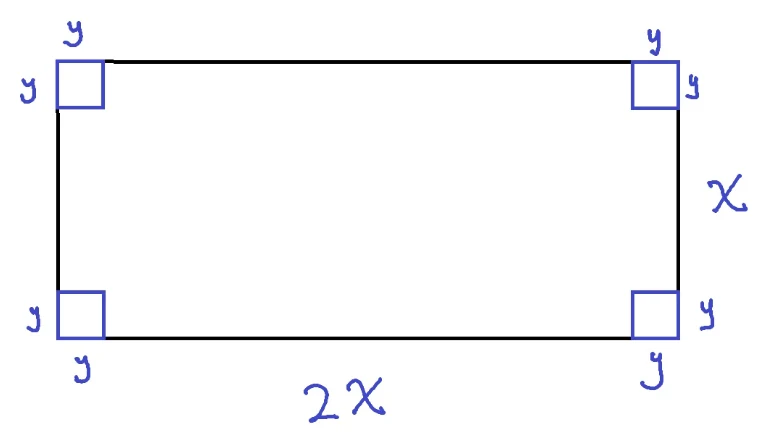
    You are given a piece of sheet metal that is twice as long as it is wide and has an area of 800 m2^2. Find the dimensions of the rectangular box that would contain a maximum volume if it were constructed from this piece of metal by cutting out squares of equal area at all four corners and folding up the sides. The box does not have a lid. Include a diagram with your setup/solution.
    Show solution
    Let xx be the width; 2x2x is the length. 2x⋅x=8002x \cdot x = 800 x2=400x^2 = 400 x=20x = 20 Let yy be the side length of the square that gets cut off. Maximize volume VV. V=(2x−2y)(x−2y)yV = (2x-2y)(x-2y)y =(40−2y)(20−2y)y= (40-2y)(20-2y)y =(800−120y+4y2)y= (800 - 120y + 4y^2)y =4y3−120y2+800y= 4y^3 - 120y^2 + 800y, where 0≤y≤100 \le y \le 10 v′=12y2−240y+800=0v' = 12y^2 - 240y + 800 = 0 3y2−60y+200=03y^2 - 60y + 200 = 0 y≈4.2y \approx 4.2 or y=15.7y = 15.7; reject y=15.7y = 15.7 since 0≤y≤100 \le y \le 10. V(0)=V(10)=0V(0) = V(10) = 0 V(4.2)=1540V(4.2) = 1540 (maximum) 20−8.4=11.620 - 8.4 = 11.6 40−8.4=31.640 - 8.4 = 31.6 ∴\therefore A box with dimensions 11.6 m×31.6 m×4.2 m11.6\text{ m} \times 31.6\text{ m} \times 4.2\text{ m} would yield the maximum volume.Worked solution
  5. Derivatives of Trig, Exp and Log

    Is the derivative of a sinusoidal function always periodic? Explain why or why not with an example.
    Show solution
    The derivative of sin⁡(x)\sin(x) is cos⁡(x)\cos(x) and the derivative of cos⁡(x)\cos(x) is −sin⁡(x)-\sin(x). Both derivative functions are periodic. Since all sinusoidal functions can be expressed as sin⁡(x)\sin(x) or cos⁡(x)\cos(x), their derivative would also be periodic. y=tan⁡xy = \tan x, y′=sec⁡2xy' = \sec^2 x is also periodic.
  6. Geometric Vectors

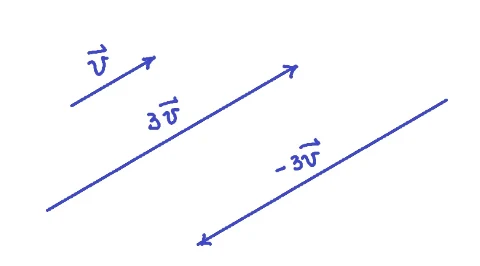
    Describe how the vectors 3v⃗3\vec{v} and −3v⃗-3\vec{v} are related v⃗\vec{v}. Include diagrams in your description.
    Show solution
    They are collinear or parallel. They have different magnitude. v⃗\vec{v} and 3v⃗3\vec{v} have the same direction. v⃗\vec{v} and −3v⃗-3\vec{v} have opposite directions.Worked solution
  7. Cartesian Vectors

    Given that u⃗=[−4,1,−8]\vec{u} = [-4, 1, -8] and v⃗=[8,−2,1]\vec{v} = [8, -2, 1], determine the angle between u⃗\vec{u} and v⃗\vec{v}.
    Show solution
    u⃗⋅v⃗=∣u⃗∣∣v⃗∣cos⁡θ\vec{u} \cdot \vec{v} = |\vec{u}||\vec{v}|\cos\theta cos⁡θ=u⃗⋅v⃗∣u⃗∣∣v⃗∣\cos\theta = \dfrac{\vec{u} \cdot \vec{v}}{|\vec{u}||\vec{v}|} =[−4,1,−8][8,−2,1]969= \dfrac{[-4, 1, -8][8, -2, 1]}{9\sqrt{69}} =−42969= \dfrac{-42}{9\sqrt{69}} θ=cos⁡−1 ⁣(−42969)\theta = \cos^{-1}\!\left(\dfrac{-42}{9\sqrt{69}}\right) ≐124.18∘\doteq 124.18^\circ ∣u⃗∣=(−4)2+(1)2+(−8)2|\vec{u}| = \sqrt{(-4)^2 + (1)^2 + (-8)^2} =9= 9 ∣v⃗∣=(8)2+(−2)2+(1)2|\vec{v}| = \sqrt{(8)^2 + (-2)^2 + (1)^2} =69= \sqrt{69} ∴ θ=124.18∘\therefore\ \theta = 124.18^\circ
  8. Lines and Planes

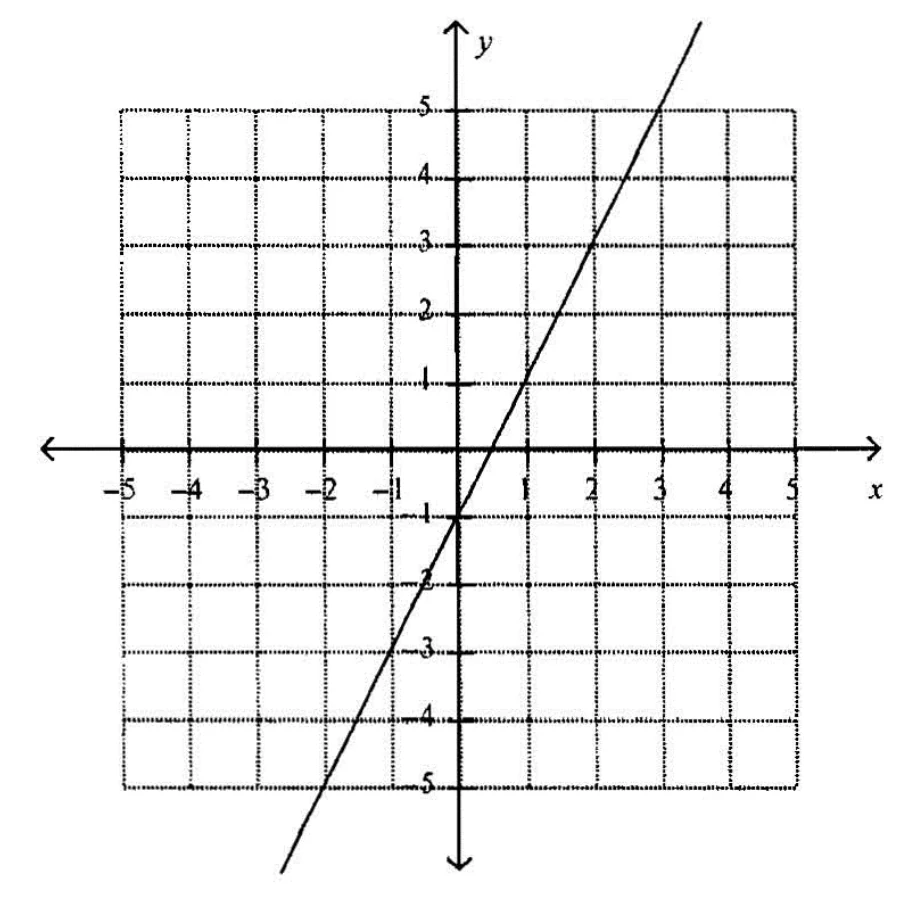
    Which vector equation represents the line perpendicular to the line shown?
    Figure for the question
    1. r⃗=(0,−1)+s ⁣(1,2),s∈R\vec{r} = \left(0,-1\right)+s\!\left(1,2\right), s \in \mathbf{R}
    2. r⃗=(0,−1)+s ⁣(−2,1),s∈R\vec{r} = \left(0,-1\right)+s\!\left(-2,1\right), s \in \mathbf{R}
    3. r⃗=(0,−1)+s ⁣(2,1),s∈R\vec{r} = \left(0,-1\right)+s\!\left(2,1\right), s \in \mathbf{R}
    4. none of these
    Show answer
    b) r⃗=(0,−1)+s ⁣(−2,1),s∈R\vec{r} = \left(0,-1\right)+s\!\left(-2,1\right), s \in \mathbf{R}

MCV4U Unit Tests FAQ

How do I study for an MCV4U unit test?+

Take the unit's practice test cold, mark it, fix the skill behind each miss, drill until it is automatic, and retest two days before.

How do I study for a calculus unit test?+

Practise each derivative rule until it is automatic, then check your algebra. In our judgment, many lost marks on a derivative are a factoring, rational expression, trig or log slip, not the rule itself.

How do I study for an MCV4U vectors test?+

Draw and label every question before you calculate, and sort intersection questions by case. The algebra is mostly familiar; picturing the objects is the hard part.

Which MCV4U unit is the hardest?+

In Martian Lab's judgment, Optimization, because you set up the function yourself, then Lines and Planes, because you have to picture objects in three dimensions.

Do I need MHF4U before MCV4U?+

Grade 12 Advanced Functions (MHF4U). The curriculum says it must come before MCV4U or at the same time, so the two can share a semester.

Practise every MCV4U unit free

Martian Lab has lessons and practice tests for every MCV4U unit, and the first test in every unit is free. No credit card required.

Get started