Grade 12 · MCV4U · Calculus & Vectors

MCV4U Dot and Cross Product Practice Test (with Solutions)

On Martian Lab the dot and cross product live in Cartesian Vectors, where every vector is written as [x, y, z]. The free test has magnitude, the angle between two vectors, adding and scaling, a vector projection, and telling a vector from a scalar. Work each part on paper, then check it against the solution.

Unit 7 of 8 in Martian Lab's MCV4U order. Your school may number its units differently.

Free Cartesian Vectors Practice Test

5 questions (7 parts), exactly as a free account gets them in the first Cartesian Vectors test on Martian Lab. Try each one on paper first, then open the answer and mark yourself.

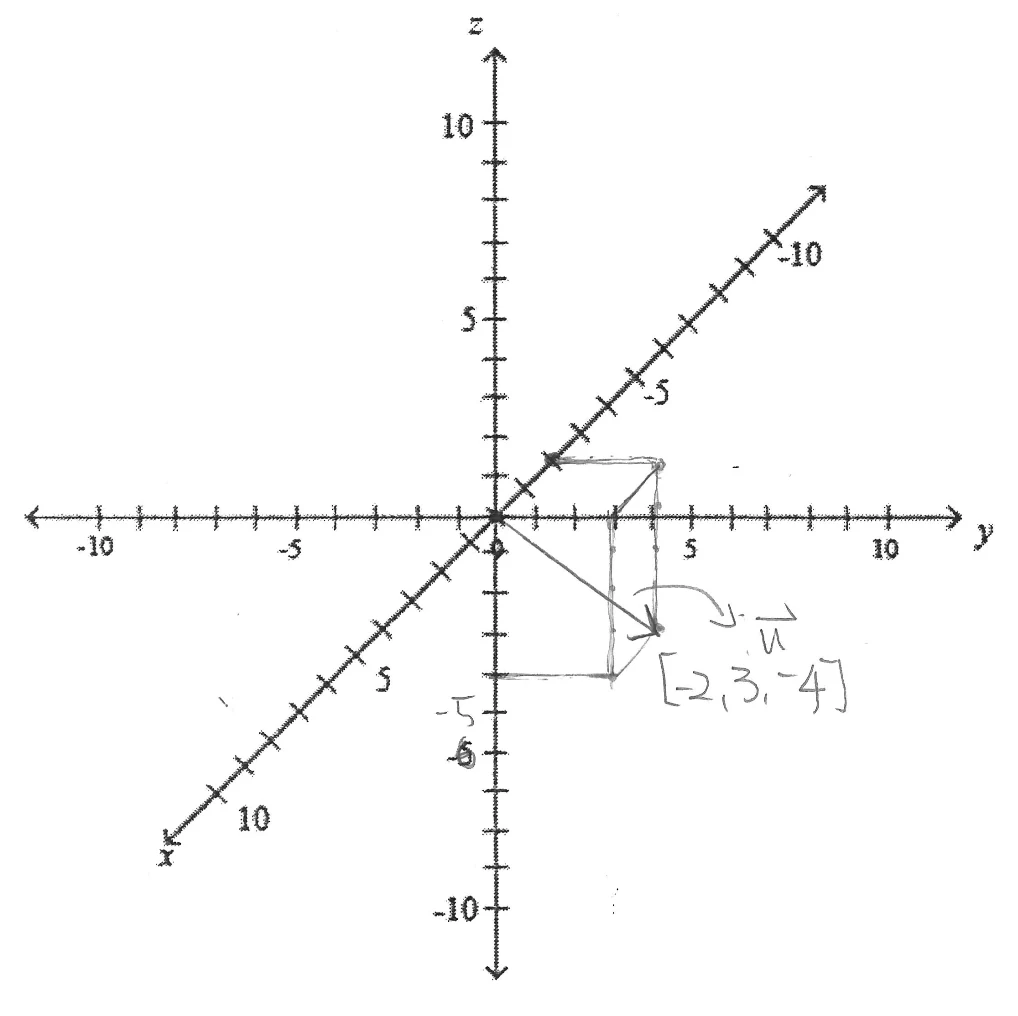
  1. Consider position vector u⃗=[−2,3,−4]\vec{u} = [-2, 3, -4],
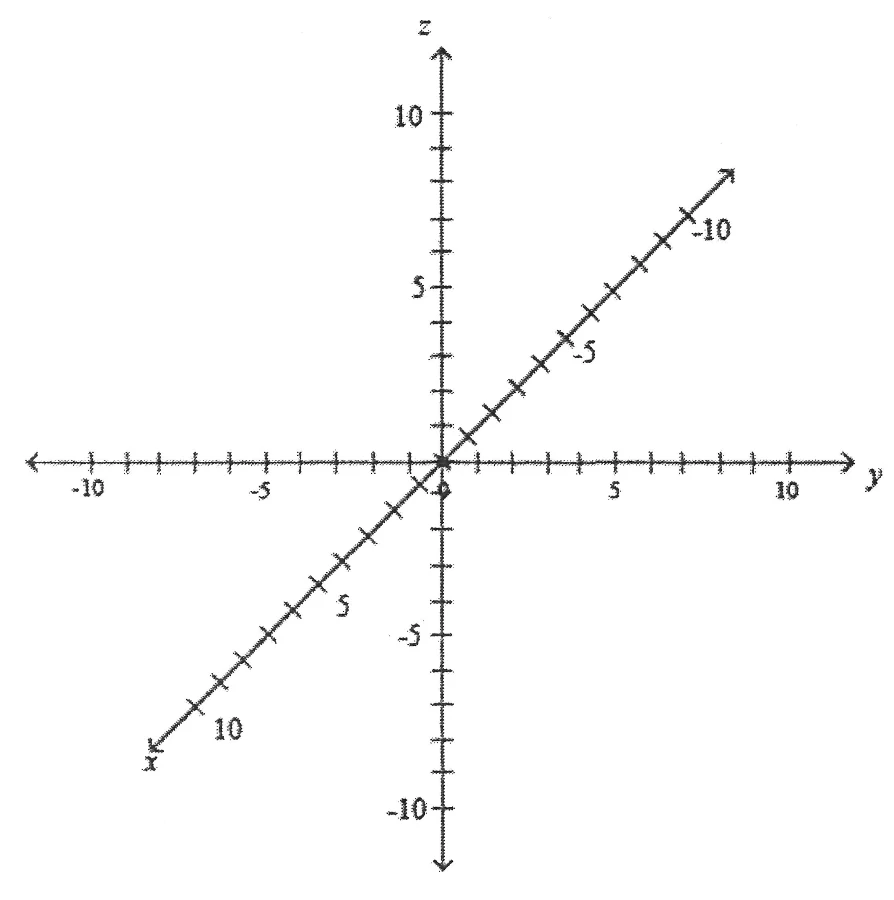
    1. Draw u⃗\vec{u} by showing it with a prism.
      Figure for the question
      Show solution
      Worked solution
    2. Find the exact value of the magnitude of u⃗\vec{u}.
      Show answer
      ∣u⃗∣=(−2)2+(3)2+(−4)2|\vec{u}| = \sqrt{(-2)^2 + (3)^2 + (-4)^2} =4+9+16= \sqrt{4 + 9 + 16} =29= \sqrt{29}
    3. Find the unit vector that is in the direction of u⃗\vec{u}.
      Show answer
      1∣u⃗∣u⃗\dfrac{1}{|\vec{u}|}\vec{u} =129[−2,3,−4]= \dfrac{1}{\sqrt{29}}[-2, 3, -4] =[−229,329,−429]= \left[-\dfrac{2}{\sqrt{29}}, \dfrac{3}{\sqrt{29}}, -\dfrac{4}{\sqrt{29}}\right]
  2. Given that u⃗=[−4,1,−8]\vec{u} = [-4, 1, -8] and v⃗=[8,−2,1]\vec{v} = [8, -2, 1], determine the angle between u⃗\vec{u} and v⃗\vec{v}.
    Show solution
    u⃗⋅v⃗=∣u⃗∣∣v⃗∣cos⁡θ\vec{u} \cdot \vec{v} = |\vec{u}||\vec{v}|\cos\theta cos⁡θ=u⃗⋅v⃗∣u⃗∣∣v⃗∣\cos\theta = \dfrac{\vec{u} \cdot \vec{v}}{|\vec{u}||\vec{v}|} =[−4,1,−8][8,−2,1]969= \dfrac{[-4, 1, -8][8, -2, 1]}{9\sqrt{69}} =−42969= \dfrac{-42}{9\sqrt{69}} θ=cos⁡−1 ⁣(−42969)\theta = \cos^{-1}\!\left(\dfrac{-42}{9\sqrt{69}}\right) ≐124.18∘\doteq 124.18^\circ ∣u⃗∣=(−4)2+(1)2+(−8)2|\vec{u}| = \sqrt{(-4)^2 + (1)^2 + (-8)^2} =9= 9 ∣v⃗∣=(8)2+(−2)2+(1)2|\vec{v}| = \sqrt{(8)^2 + (-2)^2 + (1)^2} =69= \sqrt{69} ∴ θ=124.18∘\therefore\ \theta = 124.18^\circ
  3. Find 3u⃗−2v⃗3\vec{u} - 2\vec{v} where u⃗=[−4,1,−8]\vec{u} = [-4, 1, -8] and v⃗=[8,−2,1]\vec{v} = [8, -2, 1].
    Show answer
    3u⃗−2v⃗3\vec{u} - 2\vec{v} =3[−4,1,−8]−2[8,−2,1]= 3[-4, 1, -8] - 2[8, -2, 1] =[−12,3,−24]−[16,−4,2]= [-12, 3, -24] - [16, -4, 2] =[−12−16,  3+4,  −24−2]= [-12 - 16,\; 3 + 4,\; -24 - 2] =[−28,7,−26]= [-28, 7, -26] ∴ 3u⃗−2v⃗=[−28,7,−26]\therefore\ 3\vec{u} - 2\vec{v} = [-28, 7, -26]
  4. Given u⃗=[2,−3,3]\vec{u} = [2, -3, 3] and v⃗=[3,1,4]\vec{v} = [3, 1, 4], determine the vector projection of v⃗\vec{v} onto u⃗\vec{u}.
    Show solution
    proj⁡u⃗v⃗=(v⃗⋅u⃗u⃗⋅u⃗)u⃗\operatorname{proj}_{\vec{u}}\vec{v} = \left(\dfrac{\vec{v} \cdot \vec{u}}{\vec{u} \cdot \vec{u}}\right)\vec{u} =[3,1,4][2,−3,3][2,−3,3][2,−3,3] [2,−3,3]= \dfrac{[3, 1, 4][2, -3, 3]}{[2, -3, 3][2, -3, 3]}\,[2, -3, 3] =1522 [2,−3,3]= \dfrac{15}{22}\,[2, -3, 3] =[1511,  −4522,  4522]= \left[\dfrac{15}{11},\; -\dfrac{45}{22},\; \dfrac{45}{22}\right] ∴ proj⁡u⃗v⃗=[1511,  −4522,  4522]\therefore\ \operatorname{proj}_{\vec{u}}\vec{v} = \left[\dfrac{15}{11},\; -\dfrac{45}{22},\; \dfrac{45}{22}\right]
  5. Determine whether (a⃗⋅b⃗)c⃗×a⃗{(\vec{a} \cdot \vec{b})\vec{c}} \times \vec{a} is a vector, is a scalar or is meaningless. Explain your reasoning.
    Show solution
    This gives a vector because (a⃗⋅b⃗)(\vec{a} \cdot \vec{b}) gives a scalar. (a⃗⋅b⃗)c⃗(\vec{a} \cdot \vec{b})\vec{c} is scalar times vector, which gives a vector, and the cross product with a⃗\vec{a} gives a vector.
See more questions

This Unit on Martian Lab

The lessons go from algebraic vectors through the dot product and the cross product to their applications and linear combinations.

  1. Algebraic Vectors
  2. Dot Product
  3. Cross Product
  4. Applications of the Dot & Cross Products
  5. Linear Combination

Then 4 full Cartesian Vectors practice tests to check yourself.

Start Cartesian Vectors free

Cartesian Vectors FAQ

What is on an MCV4U dot and cross product test?+

Vectors in [x, y, z] form: magnitude and unit vectors, adding and scaling, the dot product and the angle between two vectors, projections, the cross product, and the areas and volumes they measure. The free questions on this page cover magnitude, adding and scaling, the angle between two vectors, a projection and the dot product against the cross product.

How do you find the angle between two vectors?+

Use u · v = |u||v| cos θ. Divide the dot product by the product of the magnitudes, then take the inverse cosine. A negative dot product means the angle is obtuse, like the 124.18° in question 2.

How do you tell if two vectors are collinear or orthogonal?+

Collinear means one is a scalar multiple of the other, so solve a = kb one component at a time. Orthogonal means the dot product is 0.

What do the cross product and the triple product measure?+

|u × v| is the area of the parallelogram the two vectors span. |(a × b) · c| is the volume of the parallelepiped the three vectors span, and a volume of 0 means the three vectors are coplanar.

Which gives a vector, the dot product or the cross product?+

The dot product gives a scalar and the cross product gives a vector, and the cross product only exists in 3D. Question 5 uses that to decide whether an expression is a vector, a scalar or meaningless.

Cartesian Vectors Topics

One idea at a time: a short explanation, then five worked examples.

Start Practicing

No credit card required to start.

Get started