November 13, 2026

How to Study for the MCR3U Final Exam

Short answer: take one full practice test cold, then spend most of your time on the units where you lost marks, and retest a few days before the exam. Re-reading notes feels productive but shows you nothing about your gaps. Martian Lab has free MCR3U practice tests from 20 years of tutoring YRDSB and TDSB students, with a free test in each of the 7 units.

A 5-step plan for the MCR3U final

  1. Take one cold test

    Two or three weeks out, sit a full test on paper, timed, with no notes. The result is your study plan: it shows which units actually cost you marks. Start with the MCR3U final exam review, which mixes questions from every unit into one sitting. If your teacher hands out a practice examination for Grade 11 Functions, save it for step 5.

  2. Rank your units, worst first

    List the units where you lost marks and start at the top. In our judgment the usual suspects are Trigonometric Ratios (the ambiguous case of the sine law) and Rational Expressions. Is MCR3U hard? explains why.

  3. Drill one unit at a time

    For each weak unit, relearn the idea, then do questions until you get them right without looking. The MCR3U lessons cover every unit, and each unit page has its free practice test. Mix easy and hard questions, and redo the ones you got wrong the next day.

  4. Study with the formulas, then without

    Ask your teacher what you get on exam day. Drill with the MCR3U formula sheet beside you, and if you get nothing on the day, put it away for the last week. Knowing which formula a question needs is half the mark.

  5. Retest a few days before

    Redo every question you missed, then try the sample test below cold: one question from each unit. A unit you still miss gets your last study session.

Free MCR3U Sample Test

7 real questions, one from each unit, straight from the free tests on Martian Lab. Try each one on paper first, then open the answer and mark yourself.

  1. Functions & Transformations

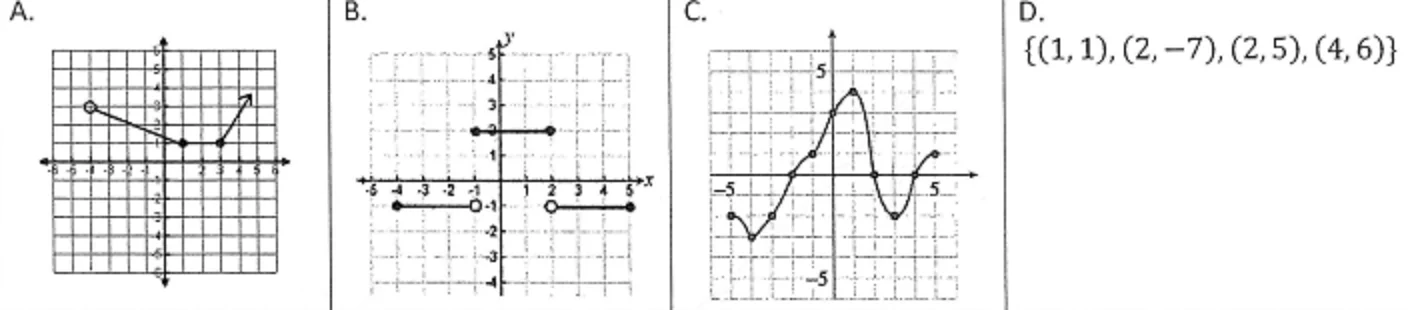
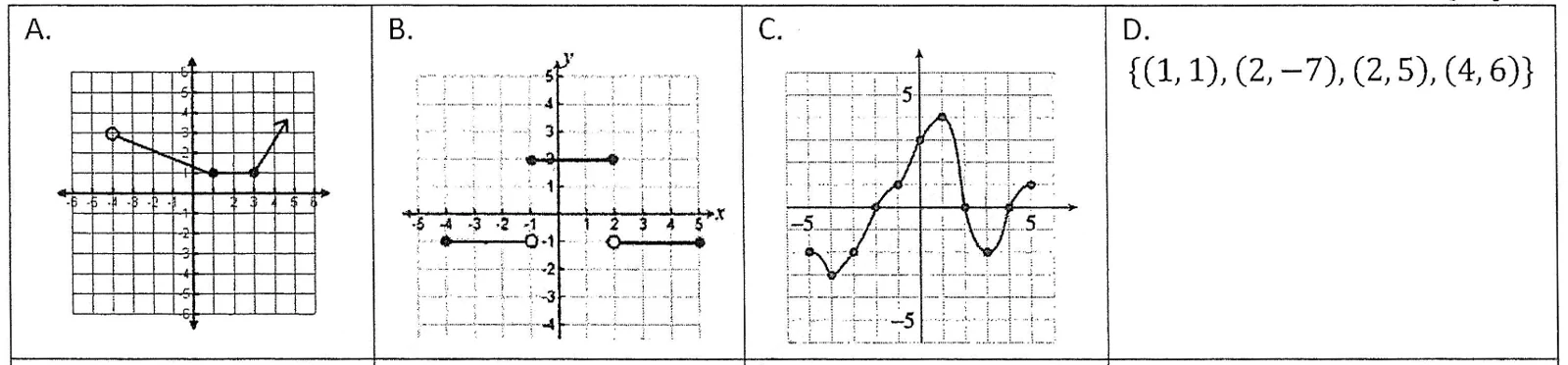
    For the following relations, fill in the table.
    ImageDomainRangeSolveIs this relation a function?
    AD =-Find xx if f(x)=1f(x)=1
    BD =R =f(2)=f(2) =
    C-R =f−1(0)=f^{-1}(0) =
    DD =--
    Figure for the question
    Show solution
    ImageDomainRangeSolveIs this relation a function?
    AD = {x∈R, x>−4}\{x \in \mathbb{R},\ x > -4\}-{x∈R, 1≤x≤3}\{x \in \mathbb{R},\ 1 \leq x \leq 3\}Yes
    BD = {x∈R, −4≤x≤5}\{x \in \mathbb{R},\ -4 \leq x \leq 5\}R = {−1,2}\{-1, 2\}f(2)=2f(2) = 2Yes
    C-R = {y∈R, −3≤y≤4}\{y \in \mathbb{R},\ -3 \leq y \leq 4\}f−1(0)=−2,2,or4f^{-1}(0) =-2, 2, or 4Yes
    DD = {1,2,4}\{1, 2, 4\}--No
    Worked solution
  2. Rational Expressions

    Simplify the following, show all your work. State restrictions if necessary. 4x6x2+7x−3−5x2x2+15x+18\dfrac{4x}{6x^2+7x-3} - \dfrac{5x}{2x^2+15x+18}
    Show solution
    =4x(2x+3)(3x−1)−5x(x+6)(2x+3)= \frac{4x}{(2x+3)(3x-1)} - \frac{5x}{(x+6)(2x+3)} =4x(x+6)−5x(3x−1)(2x+3)(3x−1)(x+6)= \frac{4x(x+6) - 5x(3x-1)}{(2x+3)(3x-1)(x+6)} =4x2+24x−15x2+5x(2x+3)(3x−1)(x+6)= \frac{4x^2 + 24x - 15x^2 + 5x}{(2x+3)(3x-1)(x+6)} =−11x2+29x(2x+3)(3x−1)(x+6)= \frac{-11x^2 + 29x}{(2x+3)(3x-1)(x+6)} x≠−32,13,−6x \neq \dfrac{-3}{2}, \dfrac{1}{3}, -6
  3. Quadratic Functions

    Express y=x2−5xy = x^2 - 5x in vertex form
    Show answer
    y=(x−52)2−254y = \left(x - \dfrac{5}{2}\right)^2 - \dfrac{25}{4}
  4. Exponential Functions

    Evaluate the expression x−3yn\dfrac{x^{-3}}{y^n} for x=4,y=7,n=−2x = 4, y = 7, n = -2.
    1. 4964\dfrac{49}{64}
    2. 6449\dfrac{64}{49}
    3. 78\dfrac{7}{8}
    4. 3136
    Show answer
    a) 4964\dfrac{49}{64}
  5. Trigonometric Ratios

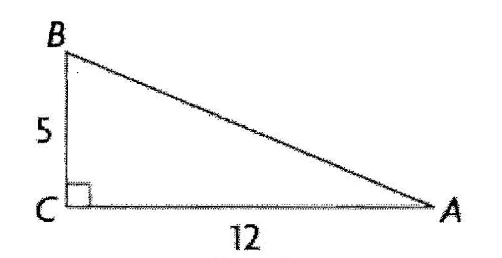
    Based on the figure, which of the following represents the length of ABAB?
    Figure for the question
    1. 12
    2. 13
    3. 14
    4. 15
    Show answer
    b) 13
  6. Trigonometric Functions

    Complete the following table.
    FunctionPeriodAmplitudePhase shiftVertical displacementRange
    y=3cos⁡(3x+180∘)−1y = 3\cos(3x + 180^\circ) - 1
    y=sin⁡34(2x+180∘)−1y = \sin\frac{3}{4}(2x + 180^\circ) - 1
    y=13cos⁡ ⁣(4x−90∘2)+3y = \frac{1}{3}\cos\!\left(4x - \frac{90^\circ}{2}\right) + 3
    y=‾cos⁡‾y = \underline{\quad} \cos \underline{\quad\quad}90∘90^\circ12\dfrac{1}{2}−60∘-60^\circ−3-3
    y=‾sin⁡‾y = \underline{\quad} \sin \underline{\quad\quad}720∘720^\circ3360∘60^\circN/A
    Show solution
    FunctionPeriodAmplitudePhase shiftVertical displacementRange
    y=3cos⁡(3x+180∘)−1y = 3\cos(3x + 180^\circ) - 1120∘120^\circ33−60∘-60^\circ−1-1{y∈R−4≤y≤2\left\{\begin{array}{l} y \in \mathbb{R} \\ -4 \leq y \leq 2 \end{array}\right.
    y=sin⁡34(2x+180∘)−1y = \sin\frac{3}{4}(2x + 180^\circ) - 1240∘240^\circ11−90∘-90^\circ−1-1{y∈R−2≤y≤0\left\{\begin{array}{l} y \in \mathbb{R} \\ -2 \leq y \leq 0 \end{array}\right.
    y=13cos⁡ ⁣(4x−90∘2)+3y = \frac{1}{3}\cos\!\left(4x - \frac{90^\circ}{2}\right) + 390∘90^\circ13\dfrac{1}{3}+11.25∘+11.25^\circ+3+3{y∈R83≤y≤103\left\{\begin{array}{l} y \in \mathbb{R} \\ \frac{8}{3} \leq y \leq \frac{10}{3} \end{array}\right.
    y=12cos⁡[2(x+60)]∘−3y = \frac{1}{2}\cos\left[2(x+60)\right]^\circ - 390∘90^\circ12\dfrac{1}{2}−60∘-60^\circ−3-3{y∈R−72≤y≤−52\left\{\begin{array}{l} y \in \mathbb{R} \\ -\frac{7}{2} \leq y \leq -\frac{5}{2} \end{array}\right.
    y=3sin⁡ ⁣[12(x−60)]∘y = 3\sin\!\left[\frac{1}{2}(x-60)\right]^\circ720∘720^\circ3360∘60^\circN/A{y∈R−3≤y≤3\left\{\begin{array}{l} y \in \mathbb{R} \\ -3 \leq y \leq 3 \end{array}\right.
  7. Discrete Functions

    The fifth term in the sequence defined by t1=3t_1 = 3, tn=tn−1−4t_n = t_{n-1} - 4 is
    1. -5
    2. -9
    3. -13
    4. -17
    Show answer
    c) -13

MCR3U Final Exam FAQ

How do I study for the MCR3U final exam?+

Take one full practice test cold, mark it honestly, then drill the units where you lost marks, worst first. Retest a few days before the exam to check the gaps closed.

When should I start studying for the MCR3U final?+

Two or three weeks out gives you time for a cold test, a pass through your weak units and a retest. With less time, skip straight to your two weakest units.

What is on the MCR3U final exam?+

All of Grade 11 Functions. Martian Lab splits it into 7 units: Functions & Transformations, Rational Expressions, Quadratic Functions, Exponential Functions, Trigonometric Ratios, Trigonometric Functions, Discrete Functions. Your teacher decides the weighting.

Which MCR3U unit is the hardest?+

In Martian Lab's judgment, Trigonometric Ratios, mostly because of the ambiguous case of the sine law, then Rational Expressions for students whose factoring is weak.

Where can I find free MCR3U practice tests?+

Martian Lab has free MCR3U practice tests from 20 years of tutoring YRDSB and TDSB students. The first test in every unit is free, and the final exam review mixes questions from all of them.

Practise every MCR3U unit free

Martian Lab has lessons and practice tests for every MCR3U unit, and the first test in every unit is free. No credit card required.

Get started